

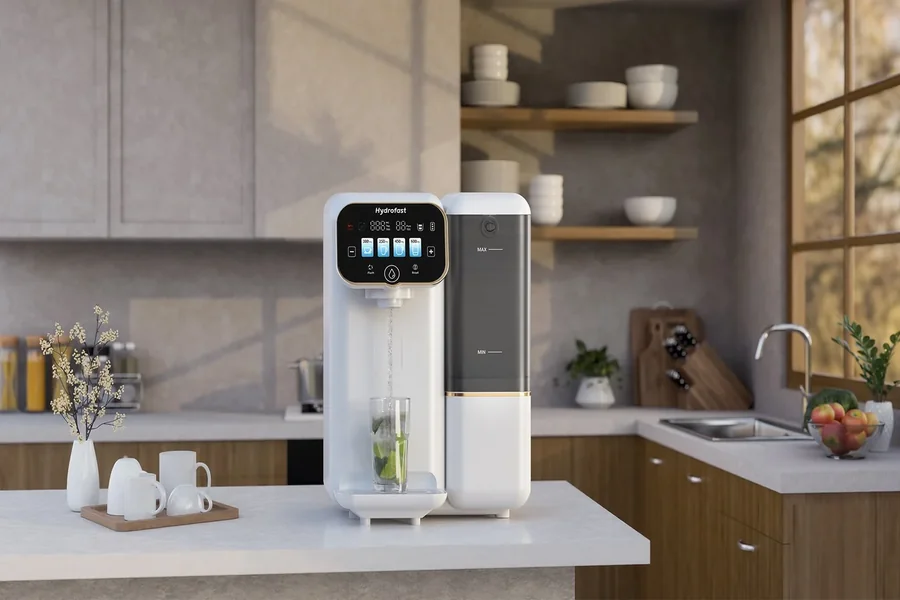
When you are living in a rented flat or sharing an apartment with roommates, choosing a water purifier is not just about finding one that fits on your kitchen counter. The first thing to consider is the water purifier’s capacity, which is often misunderstood. The capacity on the box refers to two different things: storage tank capacity and purification rate measured in litres per hour (LPH).
The tank capacity indicates how much purified water is available at any given time. The LPH shows how quickly the purifier can replenish the supply. Understand which purifier is suitable for your flat, especially if several people rely on it throughout the day. Then you will know how to buy or rent a water purifier for shared flats.
What Does Water Purifier Capacity Mean?
Two numbers indicate the water purifier’s capacity, and the fine print barely distinguishes between them.
Storage capacity refers to the tank size in litres – how much water is inside the purifier before anyone opens the tap? The purification mentioned in LPH refers to how quickly the membrane refills the tank when it is drawn down. A small kitchen unit purifies at 12-20 litres an hour.
The two figures work against each other under load. A 15-litre tank with a slow 10 LPH membrane takes 90 minutes to refill from empty. An 8-litre tank on a 20 LPH membrane recovers in about 25 minutes, which is often useful when people are coming and leaving the flat all day.
How Much Water Does a Household Need Daily?
A household needs around 10 litres of purified water per person per day for drinking and cooking combined. For the average urban Indian household (4.2 people), around 42 litres a day is considered.
The daily figure is not just a number printed on the box – it is a test for a tank-and-LPH pairing. A 6-litre tank refilling at 15 LPH can supply 42 litres over a 16-hour waking day, as it cycles through refills rather than holding it all. The tank only needs to cover a few hours – usually in the morning, not the household’s daily total.
How to Plan for Water Purifier Capacity for a Shared Flat?
The difference between the water purifier and LPH is clearly noticeable in shared apartments, as the people using the purifier keep changing. When you sign a new lease with your 2-3 roommates, it is worth considering whether to buy or rent a water purifier given the price point. A rented unit can be exchanged for a bigger tank later; however, you are stuck with a purifier purchased outright.
The flexibility is often overlooked till mid-lease. If you start living with three people and two more join, you will want to resize the purifier. Appliance rental platforms, such as Rentomojo, allow you to replace the purifier after completing a specific tenure.
Buying a water purifier also creates friction with who will take the purifier when everyone pitches in. For water purifier rentals, the subscription can be transferred to another roommate.
How to Choose the Water Purifier Capacity?
Choosing a water purifier for home depends on how many people are in the household. Also, the refill speed should be checked separately.
- 1–2 people (a single room or a couple in a shared flat): 5–6 litre tank, 12–15 LPH is usually enough, since demand is spread out rather than concentrated.
- 3–4 people (a small family or three-four flatmates): 7–9 litre tank, 15–20 LPH covers a shared kitchen without a queue at breakfast.
- 5 or more people (a joint family or a full PG floor): A high-capacity water purifier in the 10–15 litre range, 20 LPH or higher, since demand clusters into the same one or two hours.
Common Water Purifier Capacities in India
The common Indian brands have varying capacities.
DriftPro markets a 9-litre tank at 20 LPH, aimed at a household of four to six, while a comparable DriftGo model runs closer to 6.5–8.5 litres. Kent RO offers a 9-litre tank at 20 LPH, aimed at a family of four to six, while a comparable Livpure model runs closer to 6.5–8.5 litres.
For flatmates who often work from home or office, the total daily use runs higher than a nuclear family’s. The water usage is spread across more hours. A mid-size tank with a moderate LPH usually outperforms the largest tank.
Does a Bigger Tank Mean Faster Refills?
No, the tank size and refill speed are set separately. A bigger tank on a weak membrane may not work optimally. Two water purifiers can list 12 litres, but they can behave completely differently. One water purifier may fill in under 40 minutes at 20 LPH, which is why you should check the capacity and LPH.
Final Thoughts
Capacity, in the end, is two numbers that refer to one label. The tank tells you how much water is waiting; the LPH figure tells you how fast it comes back. Match both to how many people actually use the tap, not just how many names are on the lease, and the appliance stops being a bottleneck at 7 in the morning.
